What to Do If Your Uber Gets in an Accident in Texas
If your Uber gets in an accident in Texas, the most important fact is what the driver was doing at that moment. Texas law puts a different insurance policy behind the ride depending on whether the driver was carrying a passenger, waiting for a request, or off the app entirely — and the gap between them is $1 million.
The short version
- Once the driver has accepted a ride, Texas requires a $1 million policy behind that trip.
- If the driver was only logged on and waiting, the required minimum drops to $50,000 per person.
- The $1 million attaches when the driver taps accept — not when you climb in.
- The driver’s own insurer is allowed to exclude the claim completely while the app is on.
- Texas law requires the driver to tell you which of those applied if you ask.
- Driverless vehicles have carried the same requirements since September 2025.
The first thing to establish is not whose fault it was
In an ordinary wreck, the first question is who caused it. In a rideshare wreck there is a question that comes before that one, and most people never think to ask it at the scene.
What was the driver doing when it happened?
Texas treats a rideshare driver as being in one of three states, and a different pot of money sits behind each one. App off and driving for themselves: their personal policy, nothing more. App on and waiting for a ping: a modest state-mandated minimum. Ride accepted, or passenger aboard: a million dollars.
That is not a detail for the lawyers to sort out later. It decides whether a serious injury has coverage behind it or runs out of money in the first week of treatment. And the people who know the answer — the driver, and the company — are not the people whose interests line up with yours. If you were hurt and are weighing what to do next, my page on Houston rideshare accident claims covers how one of these cases gets built.
Texas anticipated this. Under Section 1954.056(b) of the Insurance Code, a rideshare driver has to carry proof of the required insurance, and after a collision has to disclose, on request, whether they were logged on to the app or engaged in a prearranged ride. That disclosure is owed to the investigating officer, to the insurers, and to any directly interested person — which includes you.
So ask. At the scene, politely and plainly: were you logged in, and did you have a ride accepted? Then get it into the crash report, because a line in the officer’s narrative is much harder to walk back three months later than your memory of a conversation.
What the insurance actually covers in Texas
Texas sets rideshare insurance minimums in Chapter 1954 of the Insurance Code. There are two tiers, and the difference between them is the whole ballgame.
| What the driver was doing | Minimum required in Texas |
|---|---|
| App off, driving personally | Their own personal auto policy only. No rideshare coverage at all. |
| Logged on, waiting for a request (§1954.052) | $50,000 per person for bodily injury $100,000 per incident $25,000 property damage |
| Ride accepted, through drop-off (§1954.053) | $1,000,000 total aggregate for death, bodily injury and property damage, per incident |
Both of the app-on tiers also carry uninsured and underinsured motorist coverage and personal injury protection where Texas law requires them. Whether either one reaches your particular claim is one of the first things worth checking, and it is frequently overlooked.
Compare the middle row to the ordinary Texas minimum of 30/60/25 and you can see the legislature was not generous with the waiting period. Fifty thousand dollars sounds like a lot until you have had spine surgery.
Does Uber pay if you get in an accident?
Usually yes, when the app was on — but “Uber pays” is a loose way of putting it, and the loose version is what gets people into trouble.
What the statute actually requires is that a policy meeting those limits exists, maintained either by the driver, by the company on the driver’s behalf, or by some combination of the two. The company is not writing checks out of goodwill. There is a commercial insurer behind that trip, and it defends claims the way commercial insurers defend claims.
Two provisions are worth knowing about, because they close doors that adjusters sometimes pretend are open.
You do not have to get denied first. Under Section 1954.055, the rideshare company’s coverage is not contingent on the driver’s personal insurer denying the claim first. If somebody tells you to run the claim through the driver’s own policy and come back when it bounces, that is not what Texas law requires.
A lapsed driver policy is not your problem. Under Section 1954.054, if the driver’s own policy has lapsed or does not provide what the chapter requires, the rideshare company has to provide that coverage beginning with the first dollar of the claim.
And in the other direction, a trap. Section 1954.151 expressly allows a personal auto insurer to exclude any loss that happens while the driver is logged on or on a ride — liability, uninsured motorist, medical payments, collision, all of it. Many drivers do not know this. They assume their own policy has them covered, discover otherwise after the wreck, and the claim everyone was relying on turns out never to have existed.
The moment that decides which policy applies
This is the part I would underline if I could keep only one paragraph of this article.
Texas defines a “prearranged ride” in Section 1954.001(3) as beginning at the time the driver accepts the request — not when the car arrives, and not when the passenger gets in. It ends when the last rider leaves the vehicle.
So the million-dollar policy is live while the driver is still three miles away, crossing town to come and get you. If a driver accepts your ride and runs a light on the way to the pickup, the person they hit is dealing with a $1 million policy, not a $50,000 one.
That timestamp lives in the company’s own records, and those records are not yours. They are one of the reasons it is worth putting a preservation request in front of the company early, rather than hoping the data is still there when somebody finally asks for it.
If an Uber driver hit you and you were not the passenger
Everything above applies to you too, and most people in this position never find out.
You are in your own car at an intersection. The other driver runs the light. You exchange information, you see a personal auto policy with state-minimum limits, and you assume that is the ceiling on your claim. Nobody mentions that the car had a rideshare app running and a passenger in the back.
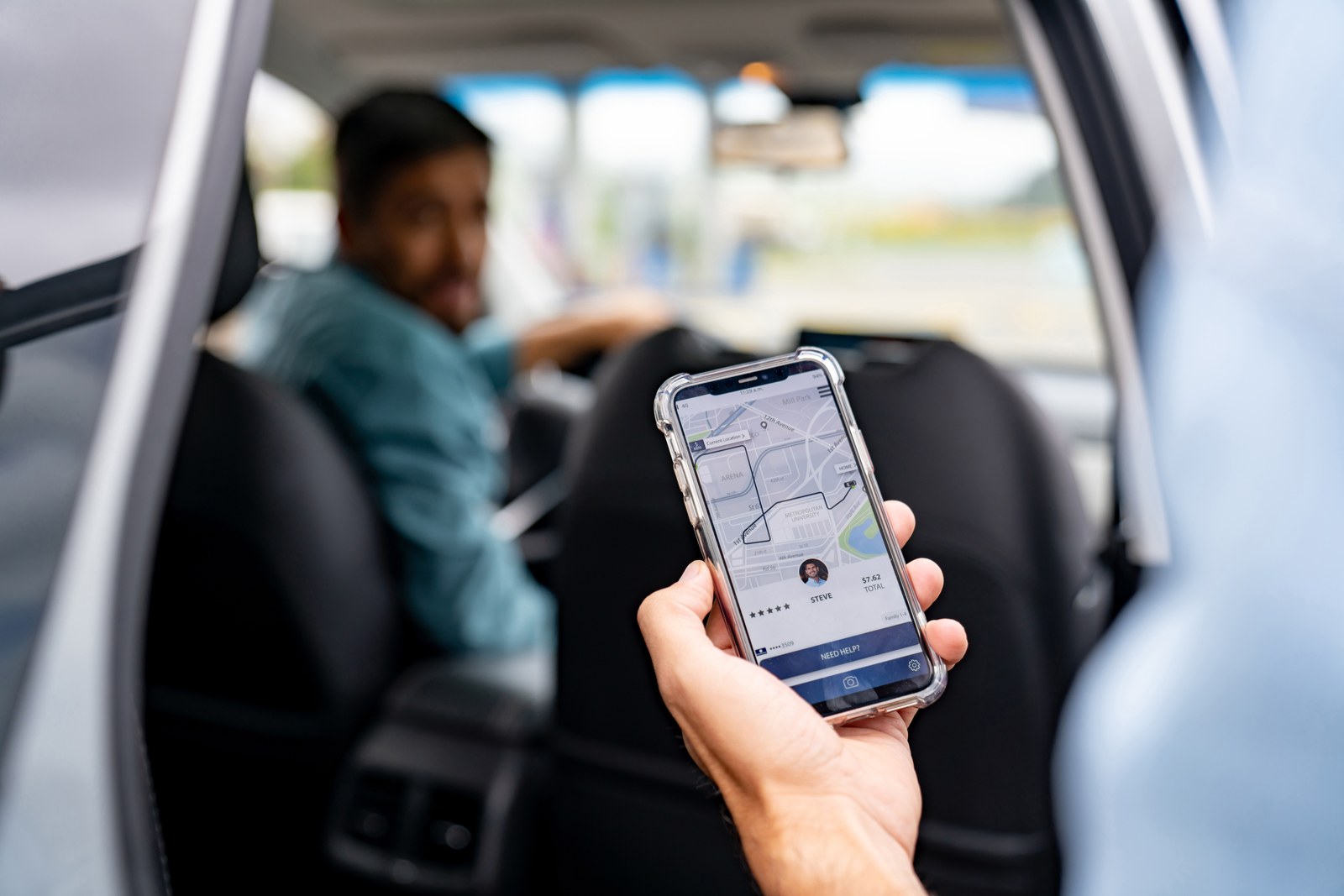
The tell is often visible at the scene: a phone in a dash mount with a navigation route up, a company sticker in the windshield, a passenger in the back seat who is plainly not family. If anything about the car suggests a rideshare, ask the question in the first section and make sure the answer reaches the crash report.
Driverless cars are covered the same way now
This one is new enough that most articles on the subject have not caught up.
Effective September 1, 2025, Texas added Section 1954.003 to the Insurance Code: an automated motor vehicle is treated as a rideshare driver for insurance purposes, and the coverage requirements of the chapter apply to it. The legislature made a matching change in Section 2402.005 of the Occupations Code, bringing autonomous vehicles inside the rideshare permitting framework.
In plain terms: if you are hurt in or by a driverless vehicle dispatched through one of these apps, the same $1 million requirement applies to that trip. There is no coverage gap simply because nobody was behind the wheel.
Why Texas does not treat Uber like a taxi
In a lot of states, a company that carries passengers for hire is a common carrier, and a common carrier owes its passengers a heightened duty of care. It is an old doctrine, and it favors injured passengers.
Texas took it off the table. Section 2402.002 of the Occupations Code states that rideshare companies, and drivers logged in to their networks, are not common carriers, contract carriers or motor carriers.
So the claim is built on ordinary negligence, the same as any other collision, and it is proved the same way: the police investigation, the physical evidence, the data the company holds, and a medical record that actually documents what happened to you. That makes the evidence matter more, not less.
What costs people money in these claims
Treating it as a normal fender bender. The information you need — the driver’s status, the trip ID, the timestamps — lives inside a company’s systems, and nobody hands it over because you asked nicely six months later.
Giving a recorded statement early. There may be three insurers involved here instead of one, and each has its own reason to ask you questions. What a recorded statement is actually for does not change because the car had an app in it.
Assuming the app-on minimum is the ceiling. It is a minimum, not a limit, and it is not the only policy that may apply. Your own underinsured motorist coverage can sit behind a rideshare crash exactly as it would behind any other.
Waiting. Texas gives you two years from the date of the crash to file suit under Section 16.003 of the Civil Practice and Remedies Code. The electronic records that prove which policy applies have a much shorter practical shelf life than that.
If you are still in treatment and the bills are arriving, who pays your medical bills in the meantime works the same way in a rideshare case as any other.
Questions people actually ask
Does Uber pay if you get in an accident?
If the driver was logged on to the app, Texas requires a policy to be in place — up to $1 million per incident once a ride has been accepted, and at least $50,000 per person while the driver was logged on and waiting. The money comes from a commercial insurance policy, not from the company as a gesture, and it is defended like any other insurance claim.
What should I do if my Uber driver got into an accident?
Get medical attention, call the police so there is a crash report, and ask the driver directly whether they were logged on to the app and whether your ride had been accepted. Texas law requires them to answer that on request. Take photographs, save the trip receipt and the ride details in your app, and get the answer about the driver’s status into the officer’s report.
Does the $1 million policy apply before the passenger gets in the car?
Yes. Texas defines a prearranged ride as beginning when the driver accepts the request, not when the passenger enters the vehicle. A crash on the way to the pickup falls under the same coverage as a crash with the passenger aboard.
An Uber driver hit me while I was in my own car. Does their rideshare insurance cover me?
If the driver was logged on to the app at the time, yes. The same coverage tiers apply to anyone they injure, not only to their passenger. The difficulty is usually proving the driver’s status, which is why it is worth asking at the scene and getting it into the crash report.
Does the driver’s own car insurance cover a rideshare accident?
Often it does not. Texas expressly permits personal auto insurers to exclude any loss occurring while the driver is logged on to a rideshare network or engaged in a ride, including liability, uninsured motorist, medical payments and collision coverage. That is one of the reasons the rideshare policy matters so much.
Do I have to claim against the driver’s policy first?
No. Texas law states that the rideshare company’s coverage is not contingent on the driver’s personal insurer denying the claim first. And if the driver’s policy has lapsed or falls short of what the law requires, the company has to provide the required coverage from the first dollar.
What if the vehicle was driverless?
Since September 1, 2025, Texas treats an automated motor vehicle as a rideshare driver for insurance purposes, and the same coverage requirements apply to the trip. A driverless vehicle dispatched through one of these apps does not create a coverage gap.
Client Reviews
Finding the policy nobody mentioned is part of the job.
Most of these cases look simpler at the start than they turn out to be. What these clients mention afterward is not the result — it is that somebody kept explaining what was happening while it happened. More on how I handle Houston rideshare accident cases, including who can be held responsible and what the first week should look like.
From the beginning, Drew explained the entire process to me and it went exactly as he predicted. He always kept us updated and looked out for our best interest. Always gave us his advice while letting us make the decision.
I’m incredibly grateful for the support and dedication my attorney Mr. Shirley showed throughout my auto injury case. From the very beginning, they kept me informed, answered every question, and truly fought to make sure I was treated fairly.…
After my accident, I was overwhelmed, stressed, and unsure about what to do next.… Every time I had questions or felt anxious about the process, they were patient, reassuring, and always kept me updated.…
Related reading
- What Texas auto insurance actually covers — the 30/60/25 minimum, and why it runs out faster than people expect.
- What a Texas case is actually worth — what the number is built from, and the three things that cut it down.
- Should you give a recorded statement? — what the adjuster is really asking for, and when to say not yet.
If you were hurt in a rideshare — as the passenger, the other driver, or someone on foot — the question of which policy applies is worth settling early, while the records still exist. Tell me what happened and I will tell you plainly what coverage is likely behind it and whether you need a lawyer at all. That costs nothing. If you want the wider picture first, here is how a Houston car accident claim works.
Where to find me
The office is at 4900 Woodway Drive, Suite 900, in Uptown Houston, just inside the 610 Loop. Most of this can be handled over the phone — but if you would rather spread the paperwork out on a table, the door is open.
This article is general information about how Texas rideshare insurance law works. It is not legal advice about your situation, it does not predict any particular result, and reading it does not create an attorney-client relationship. Statutes change and every case turns on its own facts.