Free consultation · No fee unless we win · 281-888-8137

Free consultation · No fee unless we win · 281-888-8137
Houston · Free Consultation
An Uber or Lyft wreck is not an ordinary car wreck. Which insurance policy applies — and how much of it there is — can turn on whether the app was on, off, or in the middle of a trip at the moment of impact.
When two private drivers collide, there is usually one policy on each side. When an Uber or Lyft is involved, the coverage that applies depends on the exact status of the app when the crash happened — off, waiting for a ride request, or in the middle of a trip — and each status carries a different dollar amount behind it. Uber and Lyft also classify their drivers as independent contractors, not employees, which is precisely the structure that lets the companies argue they are not the ones responsible when a driver causes a wreck. In Texas you generally have two years from the date of the crash to file suit, but the trip data that proves what the app was doing at the time does not wait that long.
If you were hit by an ordinary passenger vehicle rather than a rideshare driver, start with the Houston car accident page instead. If you are not sure whether the app was even on, call 281-888-8137 and I will help you work it out.
Drew on how Uber and Lyft's insurance actually works, who holds the trip data, and what to do in the first 24 hours.
Send a message
Rideshare cases move fastest in the first few days, before the trip data cycles out and before you have said something to Uber's or Lyft's insurer that you cannot take back. Free, no obligation, and what you send here stays between us. If it is urgent, phone is faster — 281-888-8137.
In an ordinary car wreck you are usually looking at one driver. In a rideshare wreck, the company whose logo was on the app is often the hardest party to reach — and figuring out who is actually on the hook depends on what the app was doing and who caused the crash.
Distraction from the app itself, unfamiliarity with the route, speed to finish a trip, or simple driver error.
Rarely, because the company classifies its drivers as independent contractors rather than employees — the arrangement is built to keep the company at arm’s length from what its drivers do behind the wheel.
Many rideshare crashes are caused by someone else entirely — another driver who ran a light or merged into the rideshare vehicle while you were a passenger inside it.
Uber and Lyft each carry a policy that activates once the driver’s app is on, separate from the driver’s own personal auto coverage.
If the app was off, or if the rideshare policy does not fully cover the loss, the driver’s own auto policy may still be part of the picture.
Which policy applies, and how much of it there is, depends entirely on what the app showed at the moment of the crash.
This is the single most important fact in a rideshare case, and it has nothing to do with who was driving. It has to do with what the app said. Texas law sets up three distinct coverage periods for Uber and Lyft drivers, and the amount of insurance behind your crash can swing from essentially nothing to a million dollars depending on which period you were in.
Those numbers are not optional add-ons the driver might or might not have purchased. They are the coverage tiers Texas law requires a transportation network company to carry, and they apply automatically based on the app’s status — which is exactly why establishing that status, second by second, is often the whole case.
Two things follow from that. If the ride had been accepted, there is usually a meaningful policy standing behind it. If the app was off, or the driver disputes the timing, the coverage can shrink dramatically — which is precisely the argument the rideshare company’s insurer is most likely to make.
Which tier applies depends on timestamps the rideshare company controls, not on anything visible at the scene — one more reason to get the trip receipt off your own phone before anything else.
These coverage periods and dollar amounts are set out in Texas Insurance Code Chapter 1954, which establishes statewide insurance requirements for transportation network companies like Uber and Lyft. I have written a longer walkthrough of what to do if your Uber gets in an accident, including what happens when a rideshare driver hits somebody who is not their passenger.
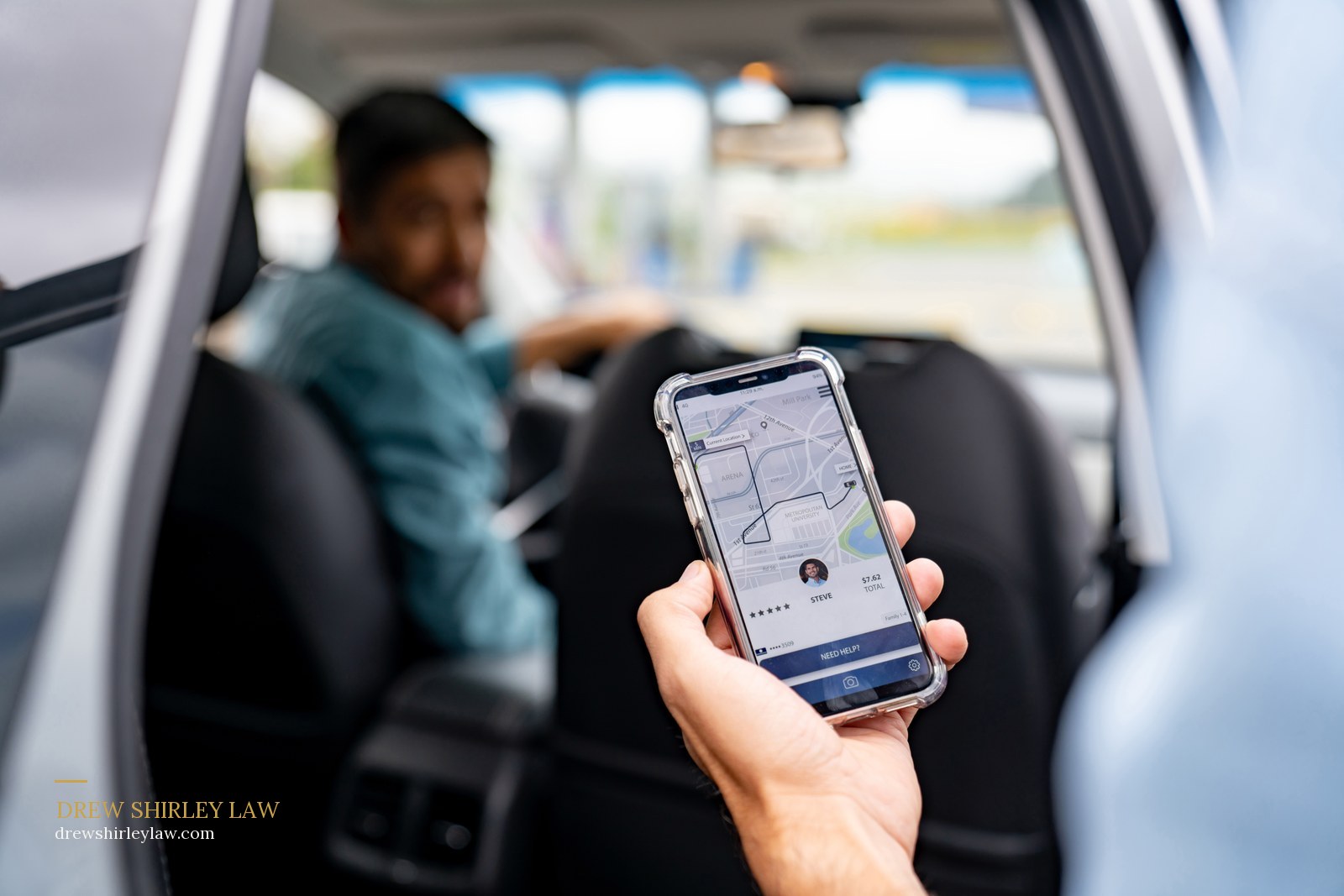
How a rideshare crash happened usually narrows down which insurance tier applies and who is likely responsible, before anyone has pulled a single record.
You were riding as a passenger when the vehicle you were in was involved in a crash. The $1,000,000 rideshare policy is typically in play here regardless of whether your own driver or someone else caused it.
The Uber or Lyft driver caused the crash — ran a light, merged unsafely, or was following too closely. Which policy responds depends on exactly where the trip was at that moment.
Another driver hit the rideshare vehicle you were in, or hit you while you were driving and the rideshare driver had nothing to do with causing it. That driver’s own insurance is the starting point, with the rideshare policy potentially standing behind it.
An Uber or Lyft driver hit you while you were walking or on a bike — often near a bar, a stadium, or a curb where rideshare vehicles are pulling in and out to pick up and drop off.
Crashes clustered around double-parking, sudden stops, and doors opening into traffic while a driver is looking for a passenger rather than at the road.
The driver was looking at the navigation prompt, the next ride request, or the passenger rating screen instead of the road ahead. The app’s own activity log is often the best evidence of this.
Uber and Lyft record a great deal about every trip — GPS location, when the app went online, when a ride was requested and accepted, and when the driver dropped the passenger off. That data is the best account of what actually happened, and neither company hands it over voluntarily. It generally takes a formal request, and in some cases a subpoena, to get it.
Rideshare cases reward moving early, because the one record that proves what the app was doing lives entirely in Uber’s or Lyft’s own hands, not yours.
Adrenaline hides injuries in the first hours. If a gap in treatment shows up in your records, that is the first thing the insurer will point at. If you are worried about paying for that care, read who pays your medical bills and how a letter of protection works.
The ride details, the driver’s name, the timestamps — screenshot all of it before it scrolls out of your trip history or the app is closed. It is the fastest proof you have of when the ride was accepted and where it stood.
Report the crash through the app’s safety line and call the police to the scene. Both create an independent record of what happened, separate from anything the company later says about the trip.
Someone may call within a day or two, and they will sound helpful. They work for the company’s insurer, not for you, and a recorded statement can be used to narrow what they end up paying.
This is the piece with a clock on it. The sooner the company is formally on notice, the more of the trip record still exists when I ask for it.
Houston is a sprawling metro without a dense public transit backbone, which makes Uber and Lyft a routine way to get around rather than an occasional convenience. A large share of that volume runs through a handful of predictable corridors — the bar and restaurant districts inside the Loop, downtown and Midtown on weekend nights, and the steady flow of airport trips to and from Bush Intercontinental and Hobby.
That concentration changes a case in a few concrete ways. It changes where the crash is likely to have happened, because curbside pickup zones outside crowded venues and airport terminals see more of these wrecks than open highway does. It changes who else may have been involved, because nightlife-heavy corridors also carry more impaired and distracted drivers on the roads around them. And it changes how fast a case needs to move, because a driver working a busy Houston market completes trip after trip, which means the app status at the exact minute of your crash needs to be pinned down before it is one more entry lost in a very long log.
If you are not yet certain which company’s driver was involved or what the crash report says, the crash report is the document that names the vehicle and the parties, and it is worth getting early. And if someone from Uber’s or Lyft’s insurer has already called you, this is what that conversation is actually for.

The office is in Houston and most cases are filed in Harris County, but a rideshare trip rarely stays inside one county — a ride that starts downtown can end in the suburbs, or start at one of the airports and cross several county lines before it is over. I handle rideshare wrecks across Fort Bend, Montgomery, Brazoria, Galveston, and Waller counties, and along the corridors where trip volume runs highest — I-10 through Katy and the Energy Corridor, I-45, US 59 and 290, Beltway 8, and the Grand Parkway.
Uber and Lyft are both headquartered far outside Texas. That does not put them out of reach; it does mean serving the right corporate entity correctly and getting a preservation request in front of the right department early, before the trip record cools.
Not directly, in most cases. Uber and Lyft classify drivers as independent contractors, which the companies rely on to argue they are not responsible for a driver’s conduct. What usually applies instead is the rideshare insurance policy tied to the app’s status at the time of the crash.
If the app was off, there is no Uber or Lyft coverage in play. The claim runs against the driver’s personal auto policy, and some personal policies exclude driving for hire entirely, which can leave a real gap.
It is possible in some circumstances, but it is not the typical path. Most rideshare claims are pursued against the applicable insurance policy — the driver’s personal policy, the contingent policy, or the $1,000,000 policy, depending on the app’s status — rather than against the company itself.
If you were a paying passenger on an active trip, the $1,000,000 third-party liability policy typically applies, regardless of whether your driver or another driver caused the crash.
You may still have a claim against the rideshare policy, depending on what the app showed at the time. Whether the driver was between rides, waiting for a request, or on an active trip changes which coverage tier applies to your claim.
It depends entirely on the app’s status. Waiting for a ride request carries contingent coverage of $50,000 per person and $100,000 per accident for bodily injury, and $25,000 for property damage. Once a ride is accepted through drop-off, coverage rises to up to $1,000,000.
That dispute is common, and it is exactly why the trip data matters so much. The app’s own timestamps — when it went online, when a ride was accepted, when it ended — are usually the evidence that settles the question, and Uber and Lyft do not hand that data over without a formal request.
Generally two years from the date of the crash, the same as other Texas personal injury claims. In practice, the trip data that proves your case is easier to obtain the sooner a formal request goes out.
Not before you have talked to your own lawyer. The adjuster works for the rideshare company’s insurer, not for you, and a recorded statement can be used later to limit what they end up paying.
The coverage that applies depends on the app’s status at the moment of the crash, the company treats its driver as an independent contractor rather than an employee, and the key evidence — trip data and GPS logs — sits entirely inside a company that does not volunteer it.
Client Reviews
A truck case brings in more parties, more evidence and more time than a car claim. These clients came through that process, and what they mention afterward is being kept informed while it ran.
From the beginning, Drew explained the entire process to me and it went exactly as he predicted. He always kept us updated and looked out for our best interest. Always gave us his advice while letting us make the decision.
I’m incredibly grateful for the support and dedication my attorney Mr. Shirley showed throughout my auto injury case. From the very beginning, they kept me informed, answered every question, and truly fought to make sure I was treated fairly.…
After my accident, I was overwhelmed, stressed, and unsure about what to do next.… Every time I had questions or felt anxious about the process, they were patient, reassuring, and always kept me updated.…
The office is at 4900 Woodway Drive, Suite 900, in Uptown Houston, just inside the 610 Loop. Most of this can be handled over the phone — but if you would rather sit down with the paperwork in front of you, the door is open.
The consultation is free, there is no obligation, and you will speak with an attorney — not a call center. If I take your case, you owe nothing unless I recover for you.